Brick slip EWI · Scotland
Brick slip finish over insulation in Greater Glasgow
Planning brick slip finishes anywhere in Greater Glasgow? We cover towns including Glasgow and Paisley, and check planning and building control for each address. On brick terraces in Greater Glasgow, slips can insulate the wall while keeping the street's look.
- Free survey and fixed written price
- Guide price from £185 per m² + scaffold, 0% VAT
- Planning and building control checked for Scotland
Free survey in Greater Glasgow
Tell us the postcode and what you need.
What you get
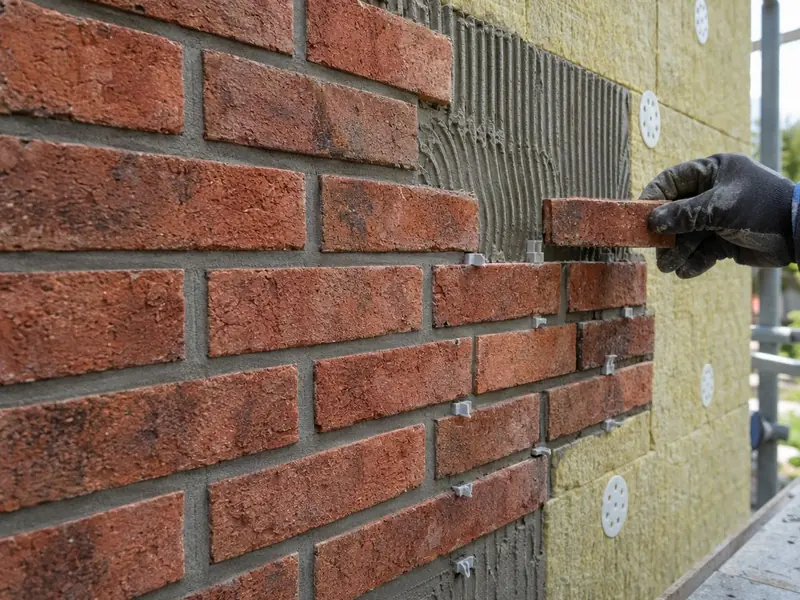
- Thin slips (typically 10–20mm) bonded to the system base coat
- Clay, concrete or flexible acrylic slips available
- Corners formed with L-shaped slips for a convincing finish
- Heavier than render, so more fixings are specified
- Can be matched to local brick colours and bonds
Before we quote in Greater Glasgow
West Central Scotland has sandstone tenements, interwar and post-war council housing including no-fines and other system-built types, and many harled (roughcast) houses.
Parts of Greater Glasgow fall in the higher wind-driven rain exposure bands, especially coastal and upland sites, so render specification, movement joints and detailing at cills, verges and the base of the wall matter more than usual.
We bring brick slip samples to Greater Glasgow surveys so you can compare them with neighbouring houses.
- Nation
- Scotland
- Region
- West Central Scotland
- Towns covered
- Glasgow, Paisley, Greenock, Bearsden, Clydebank, Newton Mearns, Bishopbriggs, Renfrew
- Guide price
- From £185 per m² + scaffold · 0% VAT
Scotland: planning and regulations
In Scotland, householder permitted development rights are set by the Scottish GPDO and are narrower for external wall changes; insulating flats or tenements, changing the appearance of a house noticeably, or working in a conservation area usually needs planning permission. Listed buildings need listed building consent. Ask your council's planning team before committing.
Work that alters an external wall's construction is covered by the building standards system; many over-cladding projects need a building warrant from the council's building standards team, and Section 6 (Energy) of the Technical Handbooks sets insulation benchmarks.
How is the brick slip system built up?
Insulation boards are fixed as for any EWI, followed by a reinforced base coat. The slips are bonded with the system adhesive, spaced for joints, then pointed. Corners use L-shaped slips so the edge looks like a solid brick.
Brick slip finish over insulation prices in Greater Glasgow
| Item | Guide price | Notes |
|---|---|---|
| Brick slip EWI | £185–£260 per m²0% VAT | Excluding scaffold |
| Brick slip feature panels | £168–£265 per m²inc VAT | Plinths, bays, features |
| Matching samples | Provided at survey |
Confirmed by a fixed written quote after survey. 0% VAT: installing insulation in a home is zero-rated until 31 March 2027, so these figures are the total; 5% applies from 1 April 2027. Prices include VAT at 20%.
From enquiry to finished wall
Enquiry
Send your postcode and a few details.
Measured survey
Walls, damp, eaves, cills and services recorded.
Written price
A fixed price with the specification attached.
Work and handover
Installed, inspected and documents handed over.
Brick slip EWI in Greater Glasgow: questions
Can I mix brick slips and render?
Yes. A brick plinth or ground floor with render above is a common combination.
Will brick slips match my neighbours' brick?
We source slips to get close in colour and texture and show samples beforehand, but an exact match to weathered brick isn't always possible.
Do brick slips fall off?
Not when installed to the system manufacturer's specification, with the right adhesive, fixings and pointing.
Do you cover all of Greater Glasgow?
Yes. We survey and quote brick slip finishes across Greater Glasgow, including Glasgow, Paisley, Greenock, Bearsden, Clydebank.
Do I need planning permission in Scotland?
In Scotland, householder permitted development rights are set by the Scottish GPDO and are narrower for external wall changes; insulating flats or tenements, changing the appearance of a house noticeably, or working in a conservation area usually needs planning permission. We check your address before quoting.