External wall insulation
EPS external wall insulation
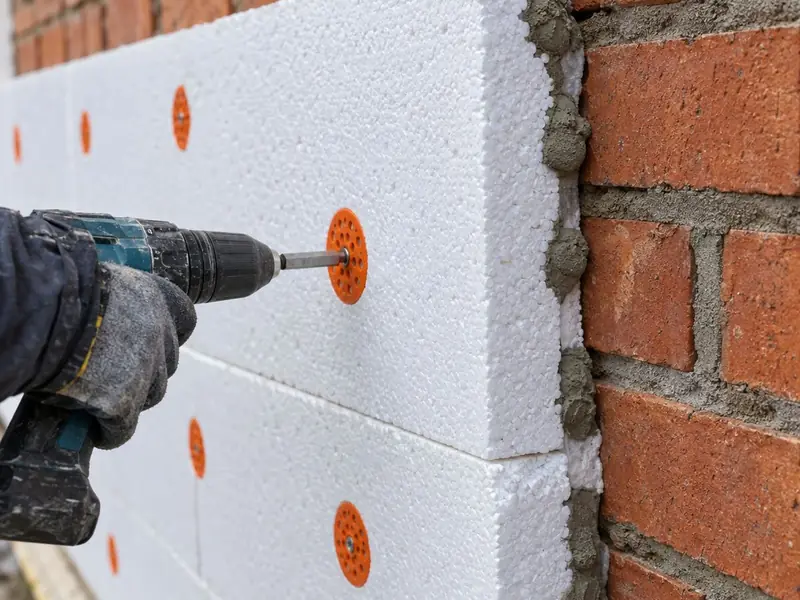
EPS external wall insulation uses expanded polystyrene boards, usually white or grey graphite-enhanced, bonded and fixed to the wall and finished in a thin-coat render. It is the lightest and most cost-effective EWI board for low-rise houses.
- Thermal conductivity around 0.031–0.038 W/mK depending on grade
- Grey graphite EPS reaches a given U-value with a thinner board
- Light boards mean fewer fixings and a faster install
- Easy to shape around bays, arches and reveals
- Used on low-rise houses; combustible, so not for taller buildings
- Finished in silicone, acrylic, mineral render or brick slip
Free survey for EPS insulation
Tell us about the property. We reply on working days.
What is EPS insulation?
Expanded polystyrene is a closed-cell foam made from beads that are expanded and moulded into boards. White EPS is the standard grade; grey EPS has graphite added, which reflects radiant heat and improves performance by roughly 15–20%, so a thinner board does the same job. Both are used inside certified render systems where the board, adhesive, fixings, mesh and finish are tested together by the manufacturer.
Typical build-up
- Board
- White or grey graphite EPS
- Conductivity (λ)
- ≈0.031–0.038 W/mK
- Typical thickness
- 70–150mm
- Fire reaction
- Combustible board within a tested system — low-rise use
- Fixings
- Adhesive plus mechanical fixings to the system spec
When is EPS the right choice?
EPS suits most two-storey houses, bungalows and park homes where the wall is sound and there are no fire-height restrictions. It is a good fit where eaves are shallow, because grey EPS can hit the target with less thickness. On buildings with a storey 11 metres or more above ground, or where the guidance asks for non-combustible materials, mineral wool is used instead.
How thick does the board need to be?
On a 225mm solid brick wall, around 90mm of grey EPS or 100–110mm of white EPS typically gets close to 0.30 W/m²K. Stone walls, concrete panels and hollow-block walls start from different points, so the system supplier's calculation for your wall sets the final thickness.
EPS external wall insulation prices
| Item | Guide price | Notes |
|---|---|---|
| EPS + silicone render | £105–£145 per m²0% VAT | Excluding scaffold |
| Grey EPS uplift | +£4–£8 per m²0% VAT | Thinner board for the same U-value |
| Bungalow, full house | £6,700–£12,8000% VAT | 55–75 m² of wall, including scaffold |
Guide prices are confirmed by a fixed written quote after a free survey. 0% VAT: installing insulation in a home is zero-rated until 31 March 2027, so these figures are the total; 5% applies from 1 April 2027.
How it works
Tell us about the property
Use the quote tool or form, or call free on 0800 088 6248.
Free survey
We measure the walls, check condition and confirm planning and building control.
Fixed written quote
The system, details, access, exclusions and VAT, in writing. Anything hidden is priced and agreed before extra work.
Installation and handover
Work planned around the weather, then inspected and documented.
EPS external wall insulation: questions
Is EPS insulation safe on a house?
EPS is used inside render systems that are fire-tested as a whole. On low-rise houses it is widely used. On taller buildings, or where guidance calls for non-combustible materials, mineral wool systems are specified instead.
White or grey EPS?
Grey graphite EPS insulates better per millimetre, so it is the pick where space is tight at the eaves or around windows. White EPS is slightly cheaper and works well where the extra thickness isn't a problem.
Will woodpeckers damage EPS?
It happens occasionally, especially near woodland. Damage is to the render and board surface and is repaired with a mesh patch and colour-matched finish.
How long does EPS last on a wall?
The board itself doesn't degrade when protected by the render system. Service life depends on the render, sealants and detailing, typically 25–30 years or more with maintenance.
Where we work
EPS external wall insulation by area
Each area page covers local planning, building control and the weather your walls face.
England
- Bedfordshire
- Berkshire
- Bristol
- Buckinghamshire
- Cambridgeshire
- Cheshire
- Cornwall
- County Durham
- Cumbria
- Derbyshire
- Devon
- Dorset
- East Riding of Yorkshire
- East Sussex
- Essex
- Gloucestershire
- Greater London
- Greater Manchester
- Hampshire
- Herefordshire
- Hertfordshire
- Isle of Wight
- Kent
- Lancashire
- Leicestershire
- Lincolnshire
- Merseyside
- Norfolk
- North Yorkshire
- Northamptonshire
- Northumberland
- Nottinghamshire
- Oxfordshire
- Rutland
- Shropshire
- Somerset
- South Yorkshire
- Staffordshire
- Suffolk
- Surrey
- Tyne and Wear
- Warwickshire
- West Midlands
- West Sussex
- West Yorkshire
- Wiltshire
- Worcestershire
Wales
Scotland
- Aberdeen and Aberdeenshire
- Argyll and Bute
- Ayrshire
- Dumfries and Galloway
- Dundee and Angus
- Edinburgh and the Lothians
- Fife
- Forth Valley
- Greater Glasgow
- Highland
- Lanarkshire
- Moray
- Orkney, Shetland and the Western Isles
- Perth and Kinross
- Scottish Borders
Northern Ireland
Related
Often considered alongside
External wall insulation
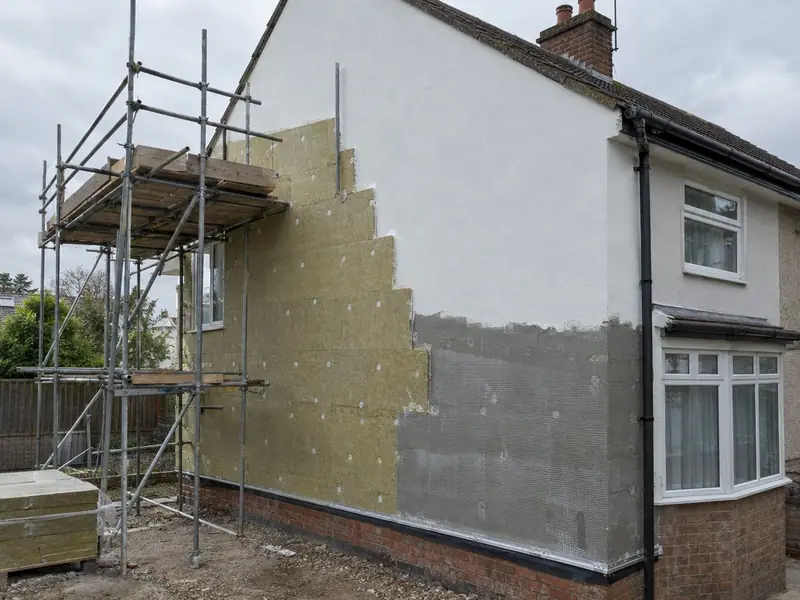
Insulation boards fixed outside and finished in render — no lost room space.
Learn more →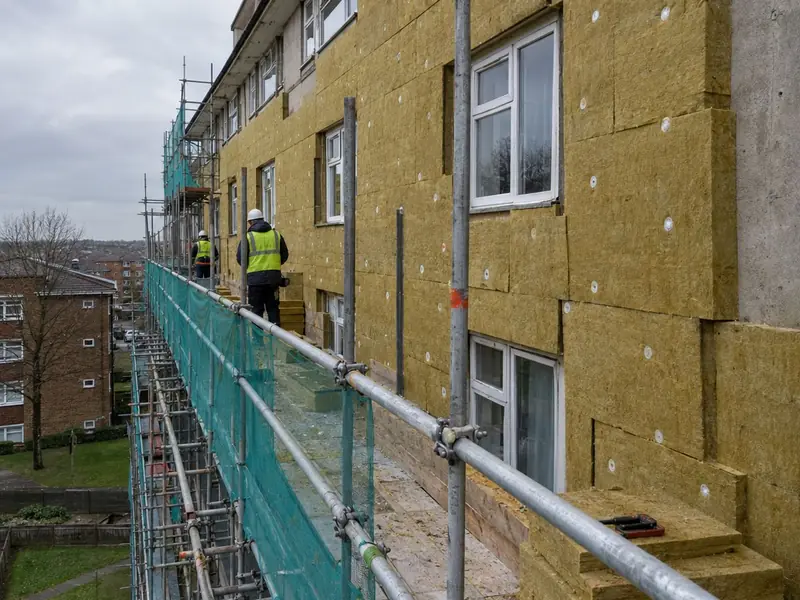
Mineral wool external wall insulation
Non-combustible, breathable slabs — the choice for flats and taller walls.
Learn more →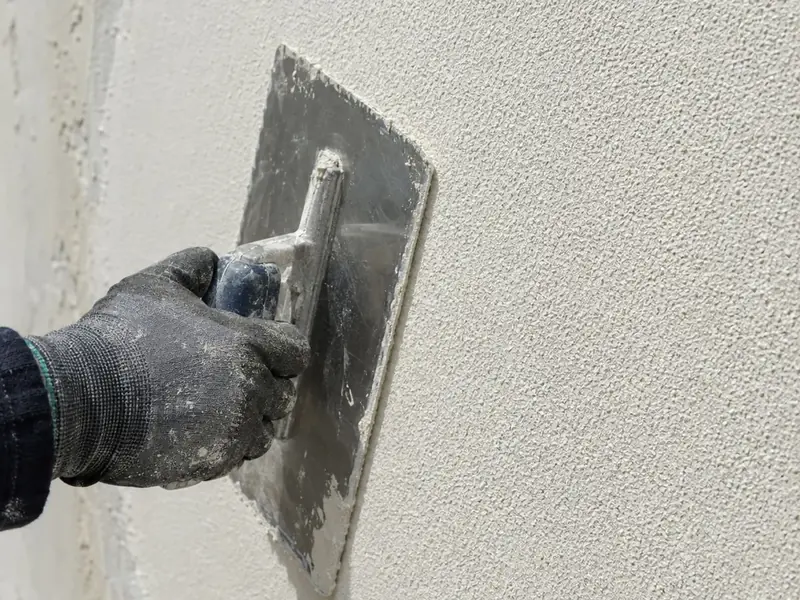
Silicone render
Thin-coat, through-coloured render that sheds water and dirt.
Learn more →
EWI and render survey
Free measured survey and fixed written quote for installation work.
Learn more →