External wall insulation · England
External wall insulation in Cumbria
Planning external wall insulation anywhere in Cumbria? We cover towns including Carlisle and Barrow-in-Furness, and check planning and building control for each address. For homes in Cumbria, the survey starts with the wall itself: solid brick, stone or concrete, and whether any old render is sound enough to insulate over.
- Free survey and fixed written price
- Guide price from £105 per m² + scaffold, 0% VAT
- Planning and building control checked for England
Free survey in Cumbria
Tell us the postcode and what you need.
What's included
- Work happens outside, so you can live at home throughout
- Installing wall insulation in homes is currently zero-rated for VAT until 31 March 2027
- Covers tired brick, pebble dash or failing render with a new finish
- Typically takes a 225mm solid brick wall from around 2.1 W/m²K to about 0.30 W/m²K with 90–110mm of board
- Cills, pipes, vents, meter boxes and the roofline detailed as part of the job
Local considerations in Cumbria
The North West has one of the largest stocks of pre-1919 solid-wall terraces in England, alongside Pennine stone houses and post-war estates.
Parts of Cumbria fall in the higher wind-driven rain exposure bands, especially coastal and upland sites, so render specification, movement joints and detailing at cills, verges and the base of the wall matter more than usual.
We plan EWI in Cumbria around the details that cause trouble later — cills, eaves, downpipes and the base of the wall above the damp-proof course.
- Nation
- England
- Region
- North West
- Towns covered
- Carlisle, Barrow-in-Furness, Kendal, Workington, Whitehaven, Penrith
- Guide price
- From £105 per m² + scaffold · 0% VAT
England: planning and regulations
For houses, external wall insulation and render are often permitted development where the finish looks similar to the existing walls. Planning permission is usually needed in conservation areas, National Parks, National Landscapes, the Broads and World Heritage Sites (where cladding a house in stone, artificial stone, pebble dash, render, timber, plastic or tiles isn't permitted development), for flats and maisonettes, for commercial buildings, under an Article 4 direction, or where the look changes noticeably. Listed buildings need listed building consent.
Renovating more than half of a wall's area — insulating it, or stripping and re-rendering it — or more than a quarter of the building's whole external envelope brings in the energy requirements of Part L, so building control needs to be involved and the wall should reach about 0.30 W/m²K where that's technically, functionally and economically feasible.
How does external wall insulation work?
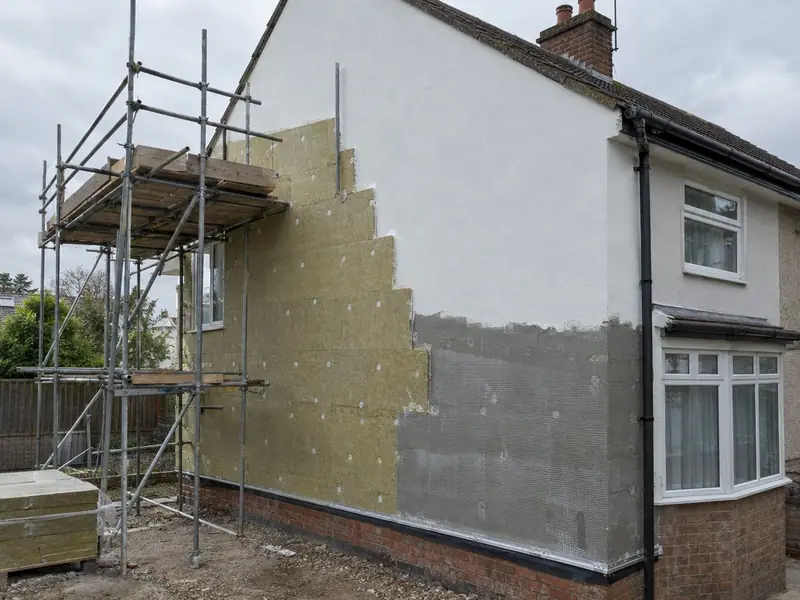
Heat moves out through a wall faster when the wall is solid or poorly insulated. EWI wraps the outside face in a continuous layer of insulation, so the masonry stays on the warm side and the cold bridges at floor and party-wall junctions are reduced. The boards are bonded with adhesive and, on most walls, mechanically fixed. A base coat with an embedded glass-fibre mesh goes over the top, then a primer and the decorative finish.
Because the wall itself sits inside the insulation, it stays warmer and drier, and the rooms keep their full size. That is the main difference from internal insulation.
External wall insulation prices in Cumbria
| Item | Guide price | Notes |
|---|---|---|
| EPS system with silicone render | £105–£145 per m²0% VAT | Most common choice for houses |
| Mineral wool system | £125–£170 per m²0% VAT | Non-combustible, vapour-open |
| Brick-slip finish over insulation | £185–£260 per m²0% VAT | Where a brick look is wanted |
| Three-bed semi, EPS + silicone (incl. scaffold) | £10,200–£17,7000% VAT | 80–100 m² of wall; depends on detailing and access |
Confirmed by a fixed written quote after survey. 0% VAT: installing insulation in a home is zero-rated until 31 March 2027, so these figures are the total; 5% applies from 1 April 2027.
What happens next
Get a guide price
Try the online quote tool for a ballpark figure.
Book the survey
A visit at a time that suits you.
Agree the quote
Nothing starts until you've signed the written price.
We do the work
Planned around weather, with you kept informed.
External wall insulation in Cumbria: questions
Does EWI need Building Regulations approval?
In England and Wales, usually. Insulating more than half of a wall's area, or more than a quarter of the building's whole external envelope, counts as renovating a thermal element, so building control needs to be involved and the wall should reach about 0.30 W/m²K where that's practical. Scotland and Northern Ireland have their own building standards processes.
Does external wall insulation cause damp?
Not when it is specified and detailed properly. Problems usually come from poor detailing: no starter track above the damp-proof course, gaps at cills and penetrations, or a vapour-closed system on a wall that needs to breathe. The survey checks moisture, ground levels and the wall type before a system is chosen.
How much does external wall insulation cost?
Our guide price for EWI is £105–£170 per m² of wall depending on the system, plus scaffolding. A typical three-bed semi with EPS and silicone render comes to roughly £10,200–£17,700 for the whole house, including scaffold. Installing insulation in a home is zero-rated for VAT until 31 March 2027, so that's the total. You get a fixed written price after a free survey.
Do you cover all of Cumbria?
Yes. We survey and quote external wall insulation across Cumbria, including Carlisle, Barrow-in-Furness, Kendal, Workington, Whitehaven.
Do I need planning permission in England?
For houses, external wall insulation and render are often permitted development where the finish looks similar to the existing walls. We check your address before quoting.