Insulated render · Scotland
Insulated render systems in Edinburgh and the Lothians
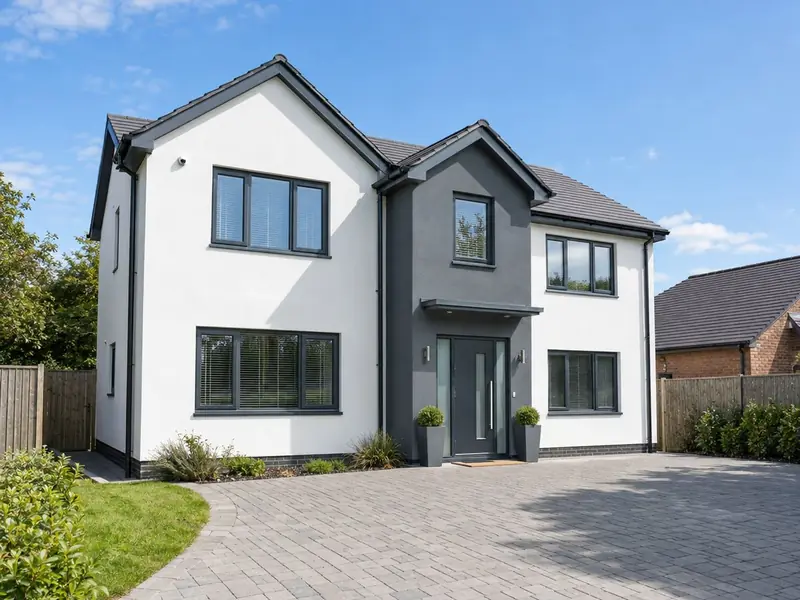
Insulated render systems across Edinburgh and the Lothians: measured survey, clear specification and a fixed written price before any work starts. Two-tone schemes, such as a darker plinth or entrance surround, are an option on houses in Edinburgh and the Lothians.
- Free survey and fixed written price
- Guide price from £105 per m² + scaffold, 0% VAT
- Planning and building control checked for Scotland
Free survey in Edinburgh and the Lothians
Tell us the postcode and what you need.
Part of every quote
- Contrasting colours for bands, plinths and features
- One system: board, adhesive, fixings, mesh, primer and render
- Designed and tested by the system manufacturer
- Suitable for houses, extensions and whole buildings
- Through-coloured finishes in hundreds of shades
Local considerations in Edinburgh and the Lothians
East Central Scotland mixes stone tenements and terraces with post-war council housing and harled bungalows and semis.
Exposure to wind-driven rain varies across Edinburgh and the Lothians: sheltered town streets fare better than walls on high ground or facing the prevailing weather, and the render, beads and cill details are chosen with that in mind.
For houses in Edinburgh and the Lothians with shallow eaves, the insulated render thickness is planned with the roofline in mind.
- Nation
- Scotland
- Region
- East Central Scotland
- Towns covered
- Edinburgh, Livingston, Musselburgh, Bathgate
- Guide price
- From £105 per m² + scaffold · 0% VAT
Approvals in Scotland
In Scotland, householder permitted development rights are set by the Scottish GPDO and are narrower for external wall changes; insulating flats or tenements, changing the appearance of a house noticeably, or working in a conservation area usually needs planning permission. Listed buildings need listed building consent. Ask your council's planning team before committing.
Work that alters an external wall's construction is covered by the building standards system; many over-cladding projects need a building warrant from the council's building standards team, and Section 6 (Energy) of the Technical Handbooks sets insulation benchmarks.
What texture will it have?
Thin-coat renders come in grain sizes, typically 1–2mm. A 1.5mm grain is a common middle ground: fine enough to look smooth from the street, coarse enough to hide minor imperfections.
Insulated render systems prices in Edinburgh and the Lothians
| Item | Guide price | Notes |
|---|---|---|
| Insulated render (EPS + silicone) | £105–£145 per m²0% VAT | Excluding scaffold |
| Mineral wool insulated render | £125–£170 per m²0% VAT | |
| Contrasting colour features | +£8–£20 per m²0% VAT | Where used |
Confirmed by a fixed written quote after survey. 0% VAT: installing insulation in a home is zero-rated until 31 March 2027, so these figures are the total; 5% applies from 1 April 2027.
What happens next
Tell us about the property
Use the quote tool or form, or call. Photos help.
Free survey
We measure, check the walls and confirm approvals.
Fixed written quote
System, details, access, exclusions and VAT in writing.
Installation
Scheduled for suitable weather, with a clear programme.
Insulated render in Edinburgh and the Lothians: questions
Will my house look different?
Yes, if it was brick or pebble dash. If you want to keep a brick look, a brick-slip finish over the insulation is an option.
Does insulated render need painting?
Through-coloured silicone and acrylic renders don't need painting. Mineral renders are usually painted with a compatible masonry paint.
How long does insulated render last?
Typically 25–30 years or more with maintenance; the manufacturer's documentation sets the service life for the specific system.
Do you cover all of Edinburgh and the Lothians?
Yes. We survey and quote insulated render across Edinburgh and the Lothians, including Edinburgh, Livingston, Musselburgh, Bathgate.
Do I need planning permission in Scotland?
In Scotland, householder permitted development rights are set by the Scottish GPDO and are narrower for external wall changes; insulating flats or tenements, changing the appearance of a house noticeably, or working in a conservation area usually needs planning permission. We check your address before quoting.