Mineral wool EWI · England
Mineral wool external wall insulation in County Durham
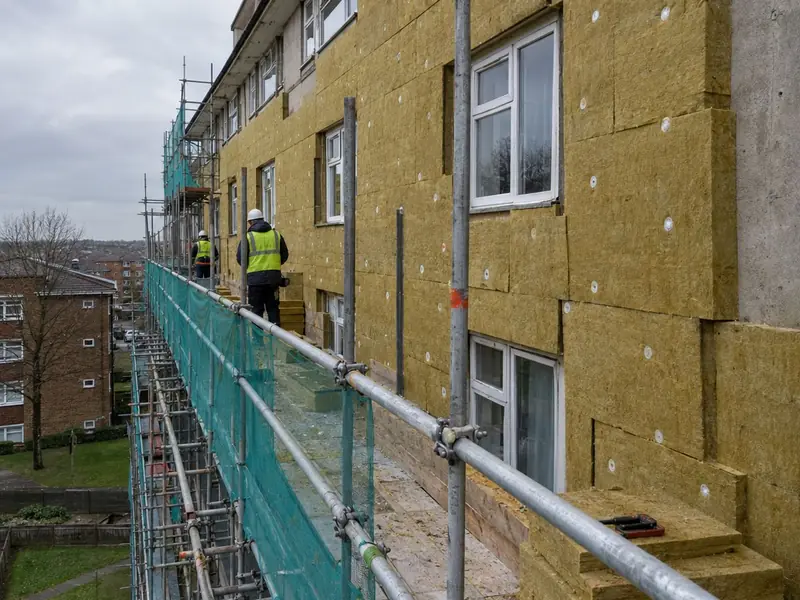
Homes and buildings across County Durham — from Darlington to Stockton-on-Tees — can get a free survey and written quote for mineral wool external wall insulation. On blocks and taller buildings in County Durham, mineral wool is the default because of the fire guidance for external walls.
- Free survey and fixed written price
- Guide price from £125 per m² + scaffold, 0% VAT
- Planning and building control checked for England
Free survey in County Durham
Tell us the postcode and what you need.
What's included
- Non-combustible board (typically Euroclass A1 or A2-s1,d0 as part of the system)
- Better sound reduction than foam boards
- Heavier than EPS, so more fixings and careful handling
- Finished in mineral or silicone render, or brick slip
- Vapour-open, so moisture in solid walls can dry outwards
Before we quote in County Durham
The North East has many solid brick terraces, including former colliery housing, plus post-war council estates with some system-built homes.
Exposure to wind-driven rain varies across County Durham: sheltered town streets fare better than walls on high ground or facing the prevailing weather, and the render, beads and cill details are chosen with that in mind.
On blocks and taller buildings in County Durham, mineral wool is the default because of the fire guidance for external walls.
- Nation
- England
- Region
- North East
- Towns covered
- Darlington, Hartlepool, Stockton-on-Tees, Durham, Peterlee, Chester-le-Street, Billingham, Consett…
- Guide price
- From £125 per m² + scaffold · 0% VAT
Permissions in England
For houses, external wall insulation and render are often permitted development where the finish looks similar to the existing walls. Planning permission is usually needed in conservation areas, National Parks, National Landscapes, the Broads and World Heritage Sites (where cladding a house in stone, artificial stone, pebble dash, render, timber, plastic or tiles isn't permitted development), for flats and maisonettes, for commercial buildings, under an Article 4 direction, or where the look changes noticeably. Listed buildings need listed building consent.
Renovating more than half of a wall's area — insulating it, or stripping and re-rendering it — or more than a quarter of the building's whole external envelope brings in the energy requirements of Part L, so building control needs to be involved and the wall should reach about 0.30 W/m²K where that's technically, functionally and economically feasible.
Combustible materials are banned in the external walls of relevant buildings 18 metres and over (regulation 7(2)), and Approved Document B guidance also covers residential buildings with a storey 11 metres or more above ground. Higher-risk buildings go through the Building Safety Regulator.
Is mineral wool required on my building?
For most two-storey houses it's a choice rather than a requirement. In England, regulation 7(2) bans combustible materials in the external walls of 'relevant buildings' 18 metres and over, and the Approved Document B guidance also covers residential buildings with a storey at 11 metres or more. Wales has its own amended rules, and Scotland restricts combustible cladding on buildings with a storey more than 11 metres above ground. We specify mineral wool wherever these apply and confirm the system's fire classification in writing.
Mineral wool external wall insulation prices in County Durham
| Item | Guide price | Notes |
|---|---|---|
| Mineral wool + mineral or silicone render | £125–£170 per m²0% VAT | Excluding scaffold |
| Mineral wool + brick slip | £195–£260 per m²0% VAT | Heavier slip systems need extra fixings |
| Three-bed semi, full house | £11,800–£20,2000% VAT | 80–100 m² of wall, including scaffold |
Confirmed by a fixed written quote after survey. 0% VAT: installing insulation in a home is zero-rated until 31 March 2027, so these figures are the total; 5% applies from 1 April 2027.
How it works
Enquiry
Send your postcode and a few details.
Measured survey
Walls, damp, eaves, cills and services recorded.
Written price
A fixed price with the specification attached.
Work and handover
Installed, inspected and documents handed over.
Mineral wool EWI in County Durham: questions
Does mineral wool get wet?
It is water-repellent and protected by the render system. Like any insulation it must not be left exposed to rain during installation, so boards are covered and work stops in wet weather.
Is mineral wool better than EPS?
Not always better — different. Mineral wool wins on fire performance, breathability and acoustics; EPS wins on cost, weight and thinner boards for the same U-value. The wall, the building height and your priorities decide it.
Can mineral wool EWI have a brick finish?
Yes. Brick slips can be bonded over mineral wool systems designed for them, with additional fixings for the extra weight.
Do you cover all of County Durham?
Yes. We survey and quote mineral wool external wall insulation across County Durham, including Darlington, Hartlepool, Stockton-on-Tees, Durham, Peterlee.
Do I need planning permission in England?
For houses, external wall insulation and render are often permitted development where the finish looks similar to the existing walls. We check your address before quoting.