Silicone render · England
Silicone render in Isle of Wight
Homes and buildings across Isle of Wight — from Ryde to Cowes — can get a free survey and written quote for silicone render. On tree-shaded or north-facing walls in Isle of Wight, silicone's water repellence helps it stay cleaner for longer.
- Free survey and fixed written price
- Guide price from £66 per m² + scaffold, inc VAT
- Planning and building control checked for England
Free survey in Isle of Wight
Tell us the postcode and what you need.
Included as standard
- Through-coloured — no painting needed
- Vapour-open, so walls can still breathe
- Fine, even grain from about 1–2mm
- Used as the finish on most EWI systems
- Water-repellent surface that dries quickly after rain
Local considerations in Isle of Wight
Homes across the South East range from inter-war semis and post-war estates, which are mostly cavity-walled, to older solid-walled cottages and Victorian town terraces.
Exposure to wind-driven rain varies across Isle of Wight: sheltered town streets fare better than walls on high ground or facing the prevailing weather, and the render, beads and cill details are chosen with that in mind.
Silicone suits most rendering jobs in Isle of Wight, either on its own or over insulation.
- Nation
- England
- Region
- South East
- Towns covered
- Ryde, Newport (Isle of Wight), Cowes, Sandown
- Guide price
- From £66 per m² + scaffold · inc VAT
England: planning and regulations
For houses, external wall insulation and render are often permitted development where the finish looks similar to the existing walls. Planning permission is usually needed in conservation areas, National Parks, National Landscapes, the Broads and World Heritage Sites (where cladding a house in stone, artificial stone, pebble dash, render, timber, plastic or tiles isn't permitted development), for flats and maisonettes, for commercial buildings, under an Article 4 direction, or where the look changes noticeably. Listed buildings need listed building consent.
Renovating more than half of a wall's area — insulating it, or stripping and re-rendering it — or more than a quarter of the building's whole external envelope brings in the energy requirements of Part L, so building control needs to be involved and the wall should reach about 0.30 W/m²K where that's technically, functionally and economically feasible.
How is silicone render applied?
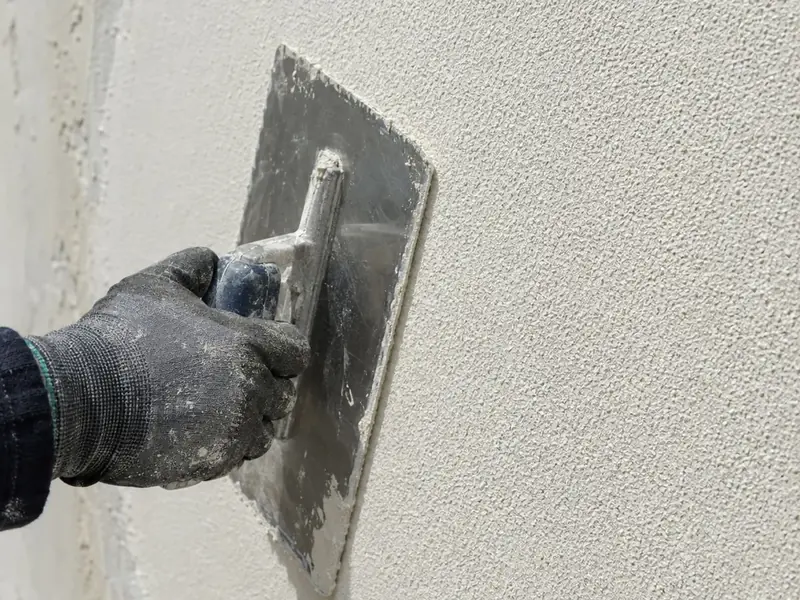
On masonry, the wall is prepared and any loose material removed. A base coat with glass-fibre mesh is applied over the whole wall to resist cracking, followed by a primer and the silicone finish, trowelled to its grain size. On EWI, the same base coat, primer and finish go over the insulation boards.
Silicone render prices in Isle of Wight
| Item | Guide price | Notes |
|---|---|---|
| Silicone render on masonry (with base coat + mesh) | £66–£102 per m²inc VAT | Excluding scaffold |
| Front and side of a semi (≈60 m²) | £3,960–£6,120inc VAT | Plus scaffold |
| As the finish on EWI | Included in EWI rates |
Confirmed by a fixed written quote after survey. Prices include VAT at 20%.
What happens next
Tell us about the property
Use the quote tool or form, or call. Photos help.
Free survey
We measure, check the walls and confirm approvals.
Fixed written quote
System, details, access, exclusions and VAT in writing.
Installation
Scheduled for suitable weather, with a clear programme.
Silicone render in Isle of Wight: questions
Does silicone render crack?
The mesh-reinforced base coat and the render's flexibility make cracking much less likely than with sand and cement, but structural movement in the wall can still show through.
Can I paint silicone render later?
Yes, with a compatible silicone paint, though through-coloured render rarely needs it.
How long does silicone render take to dry?
It's touch-dry within hours but needs dry weather above about 5°C for the first day or two to cure properly.
Do you cover all of Isle of Wight?
Yes. We survey and quote silicone render across Isle of Wight, including Ryde, Newport (Isle of Wight), Cowes, Sandown.
Do I need planning permission in England?
For houses, external wall insulation and render are often permitted development where the finish looks similar to the existing walls. We check your address before quoting.