Wood fibre EWI · Wales
Wood fibre insulation for older homes in Clwyd
Planning wood fibre external wall insulation anywhere in Clwyd? We cover towns including Wrexham and Buckley, and check planning and building control for each address. For period homes in Clwyd, the survey looks closely at existing lime mortars and any cement patching that may trap moisture.
- Free survey and fixed written price
- Guide price from £150 per m² + scaffold, 0% VAT
- Planning and building control checked for Wales
Free survey in Clwyd
Tell us the postcode and what you need.
What the job covers
- Vapour-open and hygroscopic — buffers moisture rather than trapping it
- Often the most suitable EWI where planning allows on older properties
- High density gives good protection from summer heat
- Made from a renewable material with low embodied carbon
- Thicker than foam for the same U-value
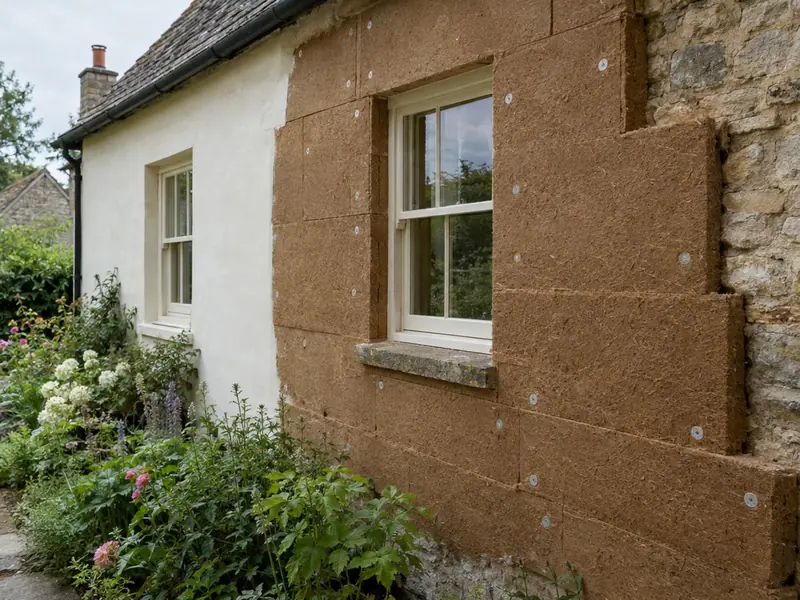
Homes and walls in Clwyd
North Wales has many solid stone and slate-built homes, Victorian seaside terraces and post-war council estates.
Exposure to wind-driven rain varies across Clwyd: sheltered town streets fare better than walls on high ground or facing the prevailing weather, and the render, beads and cill details are chosen with that in mind.
For period homes in Clwyd, the survey looks closely at existing lime mortars and any cement patching that may trap moisture.
- Nation
- Wales
- Region
- North Wales
- Towns covered
- Wrexham, Buckley, Colwyn Bay, Deeside, Flint, Rhyl, Hawarden, Rhosllanerchrugog…
- Guide price
- From £150 per m² + scaffold · 0% VAT
Permissions in Wales
Permitted development rules for houses in Wales are similar to England's: a similar-appearance finish on a house is often permitted, while conservation areas, National Parks, Areas of Outstanding Natural Beauty, flats, commercial buildings and listed buildings need permission or consent. Your local planning authority has the final word.
The Building Regulations as they apply in Wales treat insulating or re-rendering more than half of a wall's area, or more than a quarter of the building's whole envelope, as renovating a thermal element, with Approved Document L (Wales) setting the target. Building control is involved before work starts.
What finish goes over wood fibre?
A lime-based or mineral render designed for the system, applied over a reinforcing base coat. Lime finishes give the softer, slightly irregular texture that suits cottages and older terraces.
Wood fibre insulation for older homes prices in Clwyd
| Item | Guide price | Notes |
|---|---|---|
| Wood fibre + lime render system | £150–£210 per m²0% VAT | Excluding scaffold |
| Cottage, about 90 m² of wall | £15,300–£22,1000% VAT | Including scaffold |
| Lime render only (no insulation) | £78–£132 per m²inc VAT | See lime render |
Confirmed by a fixed written quote after survey. 0% VAT: installing insulation in a home is zero-rated until 31 March 2027, so these figures are the total; 5% applies from 1 April 2027. Prices include VAT at 20%.
How it works
Tell us about the property
Use the quote tool or form, or call. Photos help.
Free survey
We measure, check the walls and confirm approvals.
Fixed written quote
System, details, access, exclusions and VAT in writing.
Installation
Scheduled for suitable weather, with a clear programme.
Wood fibre EWI in Clwyd: questions
Can wood fibre go on a stone wall?
Yes, after levelling. Rubble stone is often uneven, so a levelling coat or adapted fixing method is used first.
Is wood fibre worth the extra cost?
On older solid walls the main benefit is moisture safety rather than raw U-value. If the wall needs to breathe, the cheaper option can cost more later.
Does wood fibre need a lime render?
It needs the render specified by the system manufacturer, which is usually lime or mineral based.
Do you cover all of Clwyd?
Yes. We survey and quote wood fibre external wall insulation across Clwyd, including Wrexham, Buckley, Colwyn Bay, Deeside, Flint.
Do I need planning permission in Wales?
Permitted development rules for houses in Wales are similar to England's: a similar-appearance finish on a house is often permitted, while conservation areas, National Parks, Areas of Outstanding Natural Beauty, flats, commercial buildings and listed buildings need permission or consent. We check your address before quoting.