Wood fibre EWI · Scotland
Wood fibre insulation for older homes in Fife
Get guide prices online, then a free survey and fixed quote for wood fibre external wall insulation in Fife, including Kirkcaldy and Glenrothes. For period homes in Fife, the survey looks closely at existing lime mortars and any cement patching that may trap moisture.
- Free survey and fixed written price
- Guide price from £150 per m² + scaffold, 0% VAT
- Planning and building control checked for Scotland
Free survey in Fife
Tell us the postcode and what you need.
Included as standard
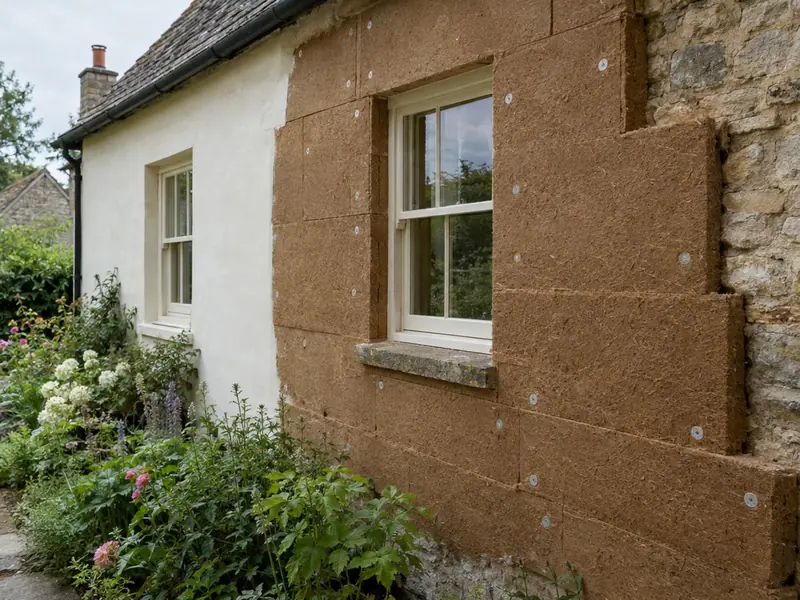
- Thicker than foam for the same U-value
- Made from a renewable material with low embodied carbon
- High density gives good protection from summer heat
- Compatible with lime renders used on traditional buildings
- Often the most suitable EWI where planning allows on older properties
Before we quote in Fife
East Central Scotland mixes stone tenements and terraces with post-war council housing and harled bungalows and semis.
Exposure to wind-driven rain varies across Fife: sheltered town streets fare better than walls on high ground or facing the prevailing weather, and the render, beads and cill details are chosen with that in mind.
For older stone and early brick properties in Fife, we look at a wood fibre and lime build-up first.
- Nation
- Scotland
- Region
- East Central Scotland
- Towns covered
- Dunfermline, Kirkcaldy, Glenrothes
- Guide price
- From £150 per m² + scaffold · 0% VAT
Scotland: planning and regulations
In Scotland, householder permitted development rights are set by the Scottish GPDO and are narrower for external wall changes; insulating flats or tenements, changing the appearance of a house noticeably, or working in a conservation area usually needs planning permission. Listed buildings need listed building consent. Ask your council's planning team before committing.
Work that alters an external wall's construction is covered by the building standards system; many over-cladding projects need a building warrant from the council's building standards team, and Section 6 (Energy) of the Technical Handbooks sets insulation benchmarks.
What finish goes over wood fibre?
A lime-based or mineral render designed for the system, applied over a reinforcing base coat. Lime finishes give the softer, slightly irregular texture that suits cottages and older terraces.
Wood fibre insulation for older homes prices in Fife
| Item | Guide price | Notes |
|---|---|---|
| Wood fibre + lime render system | £150–£210 per m²0% VAT | Excluding scaffold |
| Cottage, about 90 m² of wall | £15,300–£22,1000% VAT | Including scaffold |
| Lime render only (no insulation) | £78–£132 per m²inc VAT | See lime render |
Confirmed by a fixed written quote after survey. 0% VAT: installing insulation in a home is zero-rated until 31 March 2027, so these figures are the total; 5% applies from 1 April 2027. Prices include VAT at 20%.
How it works
Get a guide price
Try the online quote tool for a ballpark figure.
Book the survey
A visit at a time that suits you.
Agree the quote
Nothing starts until you've signed the written price.
We do the work
Planned around weather, with you kept informed.
Wood fibre EWI in Fife: questions
Is wood fibre worth the extra cost?
On older solid walls the main benefit is moisture safety rather than raw U-value. If the wall needs to breathe, the cheaper option can cost more later.
Can wood fibre go on a stone wall?
Yes, after levelling. Rubble stone is often uneven, so a levelling coat or adapted fixing method is used first.
Is wood fibre insulation fireproof?
No — it's a timber product. It chars rather than flaming readily, but it is combustible, so it's used on low-rise buildings within a tested system and never where non-combustible materials are required.
Do you cover all of Fife?
Yes. We survey and quote wood fibre external wall insulation across Fife, including Dunfermline, Kirkcaldy, Glenrothes.
Do I need planning permission in Scotland?
In Scotland, householder permitted development rights are set by the Scottish GPDO and are narrower for external wall changes; insulating flats or tenements, changing the appearance of a house noticeably, or working in a conservation area usually needs planning permission. We check your address before quoting.