Monocouche render · Scotland
Monocouche render in Argyll and Bute
Planning monocouche render anywhere in Argyll and Bute? We cover towns including Helensburgh and Dunoon, and check planning and building control for each address. For Argyll and Bute homeowners matching a new extension to an existing rendered house, we compare monocouche and silicone samples first.
- Free survey and fixed written price
- Guide price from £54 per m² + scaffold, inc VAT
- Planning and building control checked for Scotland
Free survey in Argyll and Bute
Tell us the postcode and what you need.
What's included
- Lower cost per m² than thin-coat systems on suitable walls
- Good for new blockwork and extensions
- Through-coloured, with a scraped texture
- Beads and movement joints control cracking
- Not the finish used over insulation boards
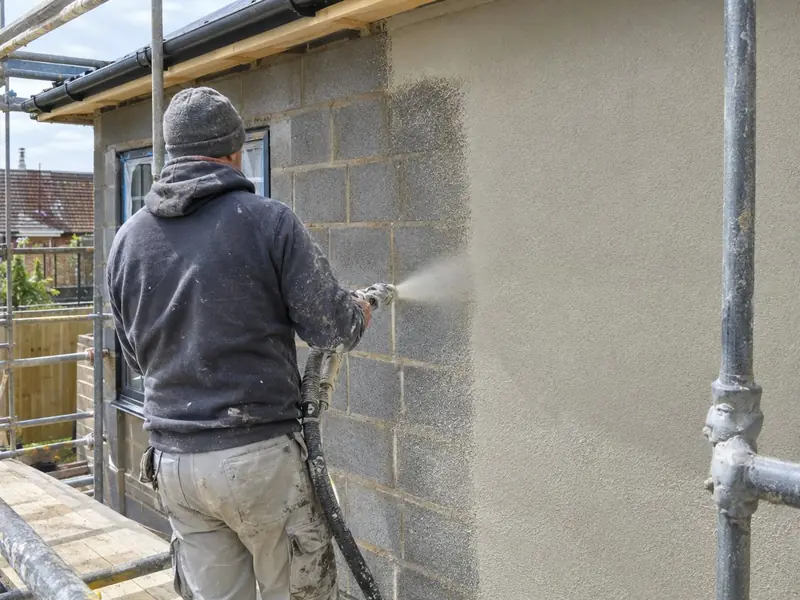
What we look for in Argyll and Bute
The Highlands and Islands have many exposed stone and harled homes, timber-framed houses and scattered rural properties.
Parts of Argyll and Bute fall in the higher wind-driven rain exposure bands, especially coastal and upland sites, so render specification, movement joints and detailing at cills, verges and the base of the wall matter more than usual.
We plan monocouche in Argyll and Bute for settled weather so each elevation can be finished in one go.
- Nation
- Scotland
- Region
- Highlands and Islands
- Towns covered
- Helensburgh, Dunoon, Oban, Campbeltown
- Guide price
- From £54 per m² + scaffold · inc VAT
Planning and building control in Scotland
In Scotland, householder permitted development rights are set by the Scottish GPDO and are narrower for external wall changes; insulating flats or tenements, changing the appearance of a house noticeably, or working in a conservation area usually needs planning permission. Listed buildings need listed building consent. Ask your council's planning team before committing.
Work that alters an external wall's construction is covered by the building standards system; many over-cladding projects need a building warrant from the council's building standards team, and Section 6 (Energy) of the Technical Handbooks sets insulation benchmarks.
Why does monocouche sometimes look patchy?
Colour variation (often called shading) can appear if it's applied in poor weather, on walls with uneven suction, or in sections on different days. Working an elevation in one go in suitable conditions keeps the colour even.
Monocouche render prices in Argyll and Bute
| Item | Guide price | Notes |
|---|---|---|
| Monocouche on blockwork | £54–£84 per m²inc VAT | Excluding scaffold |
| Single-storey extension | £2,395–£4,195inc VAT | Typical |
| Beads and movement joints | Included |
Confirmed by a fixed written quote after survey. Prices include VAT at 20%.
What happens next
Tell us about the property
Use the quote tool or form, or call. Photos help.
Free survey
We measure, check the walls and confirm approvals.
Fixed written quote
System, details, access, exclusions and VAT in writing.
Installation
Scheduled for suitable weather, with a clear programme.
Monocouche render in Argyll and Bute: questions
Monocouche or silicone for an extension?
Both work on new blockwork. Silicone over a base coat costs a little more but tends to stay cleaner.
How long does monocouche last?
Typically 20 years or more on a suitable wall, depending on exposure and detailing.
Does monocouche need painting?
No — it's through-coloured. Cleaning every few years keeps it looking fresh.
Do you cover all of Argyll and Bute?
Yes. We survey and quote monocouche render across Argyll and Bute, including Helensburgh, Dunoon, Oban, Campbeltown. Island and remote addresses are surveyed by arrangement.
Do I need planning permission in Scotland?
In Scotland, householder permitted development rights are set by the Scottish GPDO and are narrower for external wall changes; insulating flats or tenements, changing the appearance of a house noticeably, or working in a conservation area usually needs planning permission. We check your address before quoting.