Silicone render · Scotland
Silicone render in Highland
We provide silicone render across Highland, including Inverness, Fort William and Nairn, with a free survey and fixed written price. On tree-shaded or north-facing walls in Highland, silicone's water repellence helps it stay cleaner for longer.
- Free survey and fixed written price
- Guide price from £66 per m² + scaffold, inc VAT
- Planning and building control checked for Scotland
Free survey in Highland
Tell us the postcode and what you need.
Part of every quote
- Vapour-open, so walls can still breathe
- Water-repellent surface that dries quickly after rain
- Used as the finish on most EWI systems
- Through-coloured — no painting needed
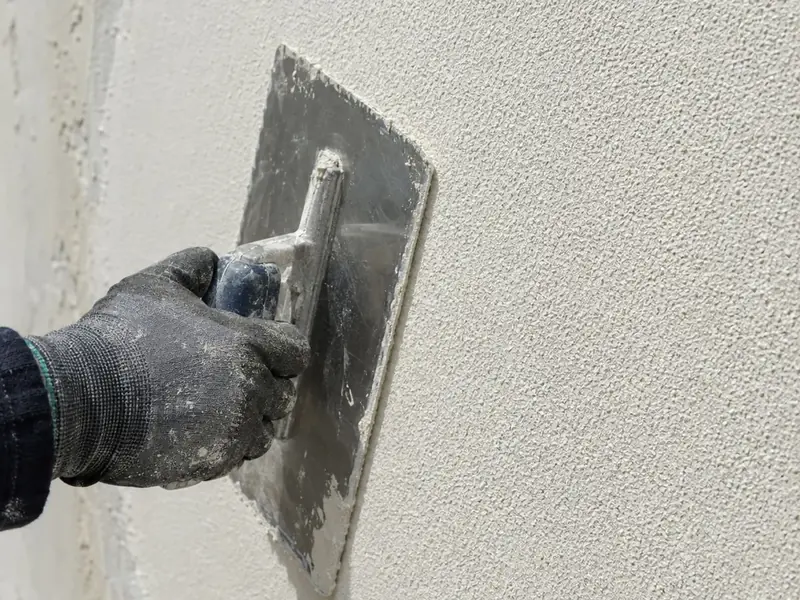
- Fine, even grain from about 1–2mm
Local considerations in Highland
The Highlands and Islands have many exposed stone and harled homes, timber-framed houses and scattered rural properties.
Parts of Highland fall in the higher wind-driven rain exposure bands, especially coastal and upland sites, so render specification, movement joints and detailing at cills, verges and the base of the wall matter more than usual.
If you're re-rendering in Highland, we'll show you what adding insulation under the silicone would cost at the same time.
- Nation
- Scotland
- Region
- Highlands and Islands
- Towns covered
- Inverness, Fort William, Nairn, Thurso, Wick
- Guide price
- From £66 per m² + scaffold · inc VAT
Scotland: planning and regulations
In Scotland, householder permitted development rights are set by the Scottish GPDO and are narrower for external wall changes; insulating flats or tenements, changing the appearance of a house noticeably, or working in a conservation area usually needs planning permission. Listed buildings need listed building consent. Ask your council's planning team before committing.
Work that alters an external wall's construction is covered by the building standards system; many over-cladding projects need a building warrant from the council's building standards team, and Section 6 (Energy) of the Technical Handbooks sets insulation benchmarks.
Silicone or monocouche?
Monocouche is a thicker single-coat cement render used mainly on new blockwork. Silicone is thinner, more flexible and usually more resistant to staining, and it's the finish used over insulation. On older or mixed walls, silicone over a mesh-reinforced base coat is generally the safer choice.
Silicone render prices in Highland
| Item | Guide price | Notes |
|---|---|---|
| Silicone render on masonry (with base coat + mesh) | £66–£102 per m²inc VAT | Excluding scaffold |
| Front and side of a semi (≈60 m²) | £3,960–£6,120inc VAT | Plus scaffold |
| As the finish on EWI | Included in EWI rates |
Confirmed by a fixed written quote after survey. Prices include VAT at 20%.
What happens next
Tell us about the property
Use the quote tool or form, or call. Photos help.
Free survey
We measure, check the walls and confirm approvals.
Fixed written quote
System, details, access, exclusions and VAT in writing.
Installation
Scheduled for suitable weather, with a clear programme.
Silicone render in Highland: questions
Does silicone render crack?
The mesh-reinforced base coat and the render's flexibility make cracking much less likely than with sand and cement, but structural movement in the wall can still show through.
Can I paint silicone render later?
Yes, with a compatible silicone paint, though through-coloured render rarely needs it.
Can silicone render go over old render?
If the old render is sound and well bonded, often yes after cleaning and priming. Hollow or cracked areas are cut out and repaired first.
Do you cover all of Highland?
Yes. We survey and quote silicone render across Highland, including Inverness, Fort William, Nairn, Thurso, Wick. Island and remote addresses are surveyed by arrangement.
Do I need planning permission in Scotland?
In Scotland, householder permitted development rights are set by the Scottish GPDO and are narrower for external wall changes; insulating flats or tenements, changing the appearance of a house noticeably, or working in a conservation area usually needs planning permission. We check your address before quoting.